Earthquake Safety for Your Home: Water Heater Strapping & Gas Shutoffs on the Wasatch Fault
The Wasatch Fault runs directly through the most densely populated part of Utah. It traces a line from Nephi in the south through Provo, Salt Lake City, Ogden, and up to Brigham City — roughly 240 miles through the backyards, basements, and foundations of more than two million people. Geologists at the University of Utah Seismograph Stations and the U.S. Geological Survey have studied this fault for decades, and the consensus is blunt: a major earthquake along the Wasatch Fault is not a question of if, but when.
The 2020 Magna earthquake, a magnitude 5.7 event that rattled the entire Salt Lake Valley, was a reminder that the ground underneath us is active. But M5.7 is modest compared to what the Wasatch Fault is capable of. Paleoseismic studies show that segments of the fault produce magnitude 7.0 to 7.5 earthquakes roughly every 1,000 to 1,300 years, and several segments are within or past their recurrence interval.
This article is not about geology for its own sake. It is about what you can do right now, in your own home, to reduce the three most dangerous consequences of a significant earthquake: fire from broken gas lines, flooding from ruptured water connections, and the loss of your stored water supply. Most of these preparations are inexpensive and straightforward.
Key Takeaways
- The Wasatch Fault is capable of producing magnitude 7.0 to 7.5 earthquakes, and several fault segments are within or past their historical recurrence interval of 1,000 to 1,300 years.
- Utah Code Chapter 28 requires water heaters to be strapped at the upper and lower thirds of the tank, anchored into wall framing — not drywall — in Seismic Design Category D zones along the Wasatch Front.
- An unstrapped water heater in an earthquake creates a trifecta of damage: fire from a broken gas line, flooding from ruptured water connections, and loss of 40 to 50 gallons of emergency drinking water.
- Automatic seismic gas shutoff valves cost $200 to $400 installed, require no power or batteries, and physically block gas flow when ground motion exceeds approximately magnitude 5.0.
- Every homeowner on the Wasatch Front should keep a dedicated gas shutoff wrench secured at or near the gas meter for immediate access after an earthquake.
Why Your Water Heater Is the Single Biggest Risk in Your House
Think about what a standard residential water heater actually is: a 120- to 150-pound cylinder sitting on the floor, top-heavy when full (a 50-gallon tank holds over 400 pounds of water), connected to both a gas line and a water line, and often sitting in a utility room, garage, or basement corner where it can topple into drywall, HVAC equipment, or an electrical panel.
When the ground shakes, an unstrapped water heater does not just tip over. It creates a cascade of failures:
- The gas line breaks. The flexible connector or rigid pipe that feeds natural gas to the burner was not designed to accommodate a 500-pound tank wrenching sideways. The connection shears, and natural gas begins flowing freely into the room.
- The water lines rupture. The cold water inlet and hot water outlet at the top of the tank snap or pull loose. Water begins flooding the space. If this is a finished basement, every square foot of flooring, drywall, and stored belongings starts taking water damage.
- You lose your emergency water supply. In a major earthquake, municipal water systems may be offline for days or weeks. That 40 to 50 gallons of clean, potable water sitting in your water heater tank is one of your most valuable emergency resources — and it just poured across your basement floor.
An unstrapped water heater turns a single event into a trifecta: fire risk, flood damage, and loss of emergency water. Strapping it properly prevents all three.
What Utah Code Requires
The Utah Residential Code, Chapter 28, requires water heaters in seismic zones to be strapped to resist horizontal displacement. Along the Wasatch Front, we are in Seismic Design Category D, which means strapping is not optional — it is code.
The requirements are specific:
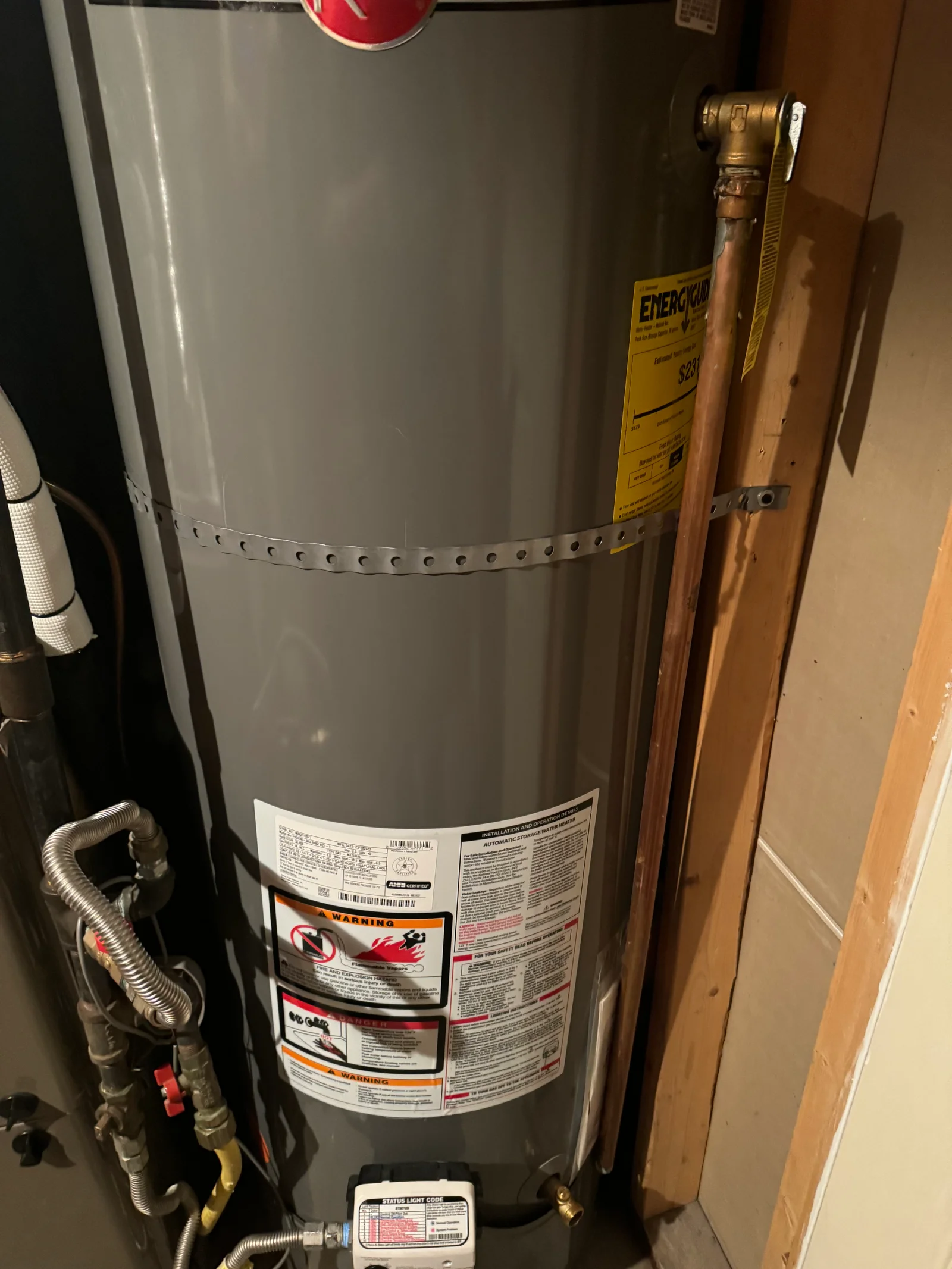
- Two straps are required: one in the upper one-third of the tank and one in the lower one-third.
- The lower strap must be at least 4 inches above the gas control valve and thermostat. This prevents the strap from interfering with the controls and ensures the tank is secured at two distinct points that resist both rocking and sliding.
- Straps must be connected to the wall framing, not just drywall. Each strap needs to be anchored into studs or a structural backing plate.
- The straps must be made of material rated for the load. Commercially available water heater strap kits designed for seismic zones meet this requirement. A piece of plumber’s strap or a ratchet strap from the garage does not.
How to Check Your Strapping
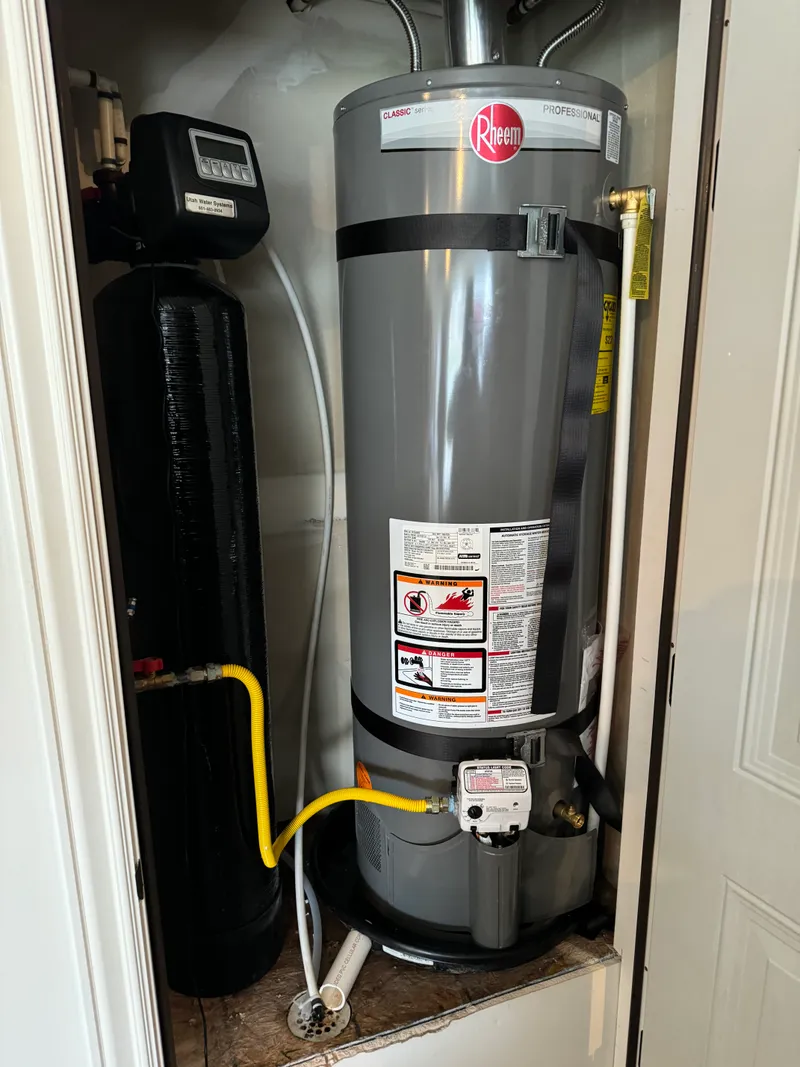
Walk over to your water heater right now and look. You should see two metal straps wrapped around the tank, each bolted or screwed into the wall behind it. If you see:
- No straps at all: Your water heater is not secured. This is the most common situation we encounter in pre-2000 Utah homes.
- One strap: Better than nothing, but not code-compliant. A single strap allows the tank to pivot around that point.
- Two straps, but loose or sagging: Straps need to be snug. If you can slide your hand between the strap and the tank, they are too loose.
- Straps anchored to drywall only: The strap is only as strong as its attachment. Drywall anchors will pull out under seismic loading. The straps must go into framing.
If your water heater is in a garage on a concrete floor next to an exterior wall, the strapping setup may involve concrete anchors rather than wood stud attachments. This is still straightforward but requires a hammer drill and appropriate concrete fasteners.
Seismic Gas Shutoff Valves: The Most Underused Safety Device in Utah
After the 2020 Magna earthquake, there was a brief spike in interest in seismic gas shutoff valves. That interest faded quickly, which is unfortunate because these devices are remarkably effective and surprisingly affordable.
A seismic gas shutoff valve installs on the gas line at the meter, outside your house. It contains a weighted mechanism that, when shaken by ground motion above a certain threshold (typically around magnitude 5.0 at the device location), drops a ball or weight into the gas flow path and physically blocks gas from entering the house.
Key facts about seismic gas shutoff valves:
- Cost: $200 to $400 installed by a licensed professional. The valve itself is typically $100 to $200, with the balance being labor.
- No power required. The valve is purely mechanical. It does not need electricity, batteries, or a Wi-Fi connection.
- Reset is manual. After the valve trips, a licensed technician (your gas company or a plumber) needs to reset it. This is by design — you want a professional to verify there are no gas leaks in the house before restoring service.
- Building code allows them. They are listed, tested devices (ASCE 25, CSA 6.9). Some California jurisdictions require them. Utah does not mandate them yet, but they are fully code-compliant to install.
- False trips are rare with quality valves. Modern seismic shutoff valves are calibrated to ignore minor tremors, heavy truck traffic, and normal vibration. They trip on actual seismic events.
We consider a seismic gas shutoff valve one of the highest-value safety investments a Utah homeowner can make. For the cost of a nice dinner out, you eliminate the possibility of your gas system feeding a fire after a major earthquake.
The Gas Shutoff Wrench
Even without an automatic valve, every homeowner on the Wasatch Front should know how to manually shut off their gas at the meter — and have the tool to do it.
The gas meter shutoff is a quarter-turn valve located on the riser pipe at the meter, typically on the exterior of your house. It requires a crescent wrench or a dedicated gas shutoff wrench to turn. When the valve handle is parallel to the pipe, gas is flowing. Turn it 90 degrees so the handle is perpendicular to the pipe, and the gas is off.
Keep a dedicated wrench secured to the meter or within a few steps of it. After a major earthquake, you may be disoriented. You may be in the dark. You do not want to be rummaging through a toolbox in the garage. A wrench zip-tied to the gas meter riser is visible, accessible, and ready.
Important: Only shut off the gas if you smell gas, hear gas hissing, see damage to the gas piping, or if there is a fire. Do not shut it off as a precaution if you do not observe any signs of a leak. Once you shut off the gas, you will need Dominion Energy or a licensed professional to turn it back on and relight all pilot lights.
Beyond the Water Heater: Other Seismic Vulnerabilities
Unreinforced Masonry Chimneys
If your home was built before 1990 and has a brick chimney, there is a high probability it is unreinforced masonry. These chimneys are one of the most common sources of earthquake damage and injury in Utah.
During the 2020 Magna earthquake, dozens of masonry chimneys across the Salt Lake Valley cracked, shed bricks, or partially collapsed. In a larger event, these chimneys can collapse onto roofs, onto parked cars, or onto people exiting the building.
If you have an unreinforced masonry chimney, your options include:
- Bracing: A structural engineer can design a bracing system that ties the chimney to the roof framing.
- Replacement: Replace the masonry chimney with a modern insulated metal chimney system. This also improves fire safety.
- Removal: If the chimney serves a fireplace that is no longer used or a furnace that has been converted to direct-vent, removing the chimney entirely eliminates the hazard.
Flexible Gas Connectors
Older homes may have rigid black iron pipe connections to gas appliances with no flexible section. In an earthquake, the appliance shifts, the pipe does not, and the connection breaks. Modern corrugated stainless steel flexible gas connectors (CSST appliance connectors) are designed to absorb movement. If your gas appliances are connected with rigid pipe all the way to the appliance, having a flexible connector installed on each one is a worthwhile upgrade.
Note: We are talking about short appliance connectors here, not the flexible gas piping (CSST) that runs through walls and floors. CSST distribution piping has its own bonding requirements, which is a separate topic.
Securing Your Furnace and Other Heavy Equipment
Your furnace, if it is a floor-standing unit, should also be secured against seismic displacement. This is less commonly discussed than water heater strapping, but the same principle applies: a gas-fired appliance that shifts off its base can break its gas connection. Most furnace installations sit on a platform or directly on the floor without any lateral restraint. Adding angle brackets or seismic straps to a furnace is inexpensive insurance.
Water Supply Preparedness
If a magnitude 7.0+ earthquake hits the Wasatch Front, the Jordan Valley Water Conservancy District and other local water providers have acknowledged that distribution mains will likely break in multiple locations. Repairs could take days to weeks in some areas.
Your strapped, intact water heater gives you 40 to 50 gallons immediately. But you should also:
- Store additional water. FEMA recommends one gallon per person per day for a minimum of three days. For a family of four, that is 12 gallons minimum, though two weeks of supply is better.
- Know how to drain your water heater. The drain valve at the bottom of the tank lets you access the stored water. Make sure you know where it is and that you have a short hose that fits the valve. Practice draining a quart of water so you know the process.
- Consider a water BOB or similar device. These are large food-grade plastic bags designed to fill a bathtub and store 100 gallons of water. If you get earthquake warning (even a few seconds from the ShakeAlert system), filling a tub could be worthwhile.
A Room-by-Room Earthquake Safety Walkthrough
Here is a practical walkthrough of what to check in your home:
Utility Room / Mechanical Room:
- Water heater: two straps, properly anchored, snug
- Furnace: secured against lateral movement
- Gas connections: flexible connectors on all appliances
- Gas shutoff wrench: accessible at the meter
- Consider: seismic gas shutoff valve at meter
Kitchen:
- Gas range: flexible connector in good condition
- Secure heavy items on upper shelves (these become projectiles)
- Know where the gas shutoff behind the range is located
Garage:
- If your water heater is in the garage, ensure strapping is anchored to framing, not drywall over stud
- Secure tall shelving units to wall studs
- Ensure vehicles are not parked where a toppling water heater would block the door
Exterior:
- Inspect masonry chimney for existing cracks or deterioration
- Locate gas meter and shutoff valve
- Check that the gas shutoff wrench is in place
- Inspect foundation for existing cracks (document them now so you can identify new damage after an event)
The Cost of Preparedness vs. the Cost of Inaction
Let us put real numbers on this:
| Preparation | Approximate Cost |
|---|---|
| Water heater strap kit (DIY) | $20-$40 |
| Professional water heater strapping | $100-$200 |
| Seismic gas shutoff valve (installed) | $200-$400 |
| Gas shutoff wrench | $10-$15 |
| Flexible gas connectors (per appliance, installed) | $75-$150 |
| CO detectors (3-pack) | $60-$100 |
For under $1,000, you can address every major gas and water vulnerability in your home. Compare that to the cost of a house fire started by a broken gas line, or a flooded basement, or being without water for a week. The math is not close.
Take Action This Week
Earthquake preparedness is one of those things that everyone agrees is important and almost nobody actually does. The 2020 Magna quake got people thinking, but most of that urgency has faded. The Wasatch Fault has not gotten any less active in the intervening years.
Here is what we recommend you do this week:
- Check your water heater strapping. If it is not strapped, or not strapped correctly, fix it or call us.
- Locate your gas meter and shutoff valve. Buy a wrench and secure it near the meter.
- Ask us about a seismic gas shutoff valve. It is one of the best investments in home safety you can make.
- Check your CO detectors. Press the test button. Replace batteries. If you do not have CO detectors, install them.
- Look at your chimney. If it is unreinforced masonry, talk to a structural engineer about your options.
Our plumbing team handles water heater strapping, seismic gas shutoff valve installation, and flexible gas connector upgrades. We serve the entire Wasatch Front and can usually schedule these services within a few days. Contact us or call (385) 401-9490 to get your home earthquake-ready.
The Wasatch Fault is not waiting. Neither should you.
Topics