Sewer Line Problems in Northern Utah: What Homeowners Need to Know Before It's Too Late
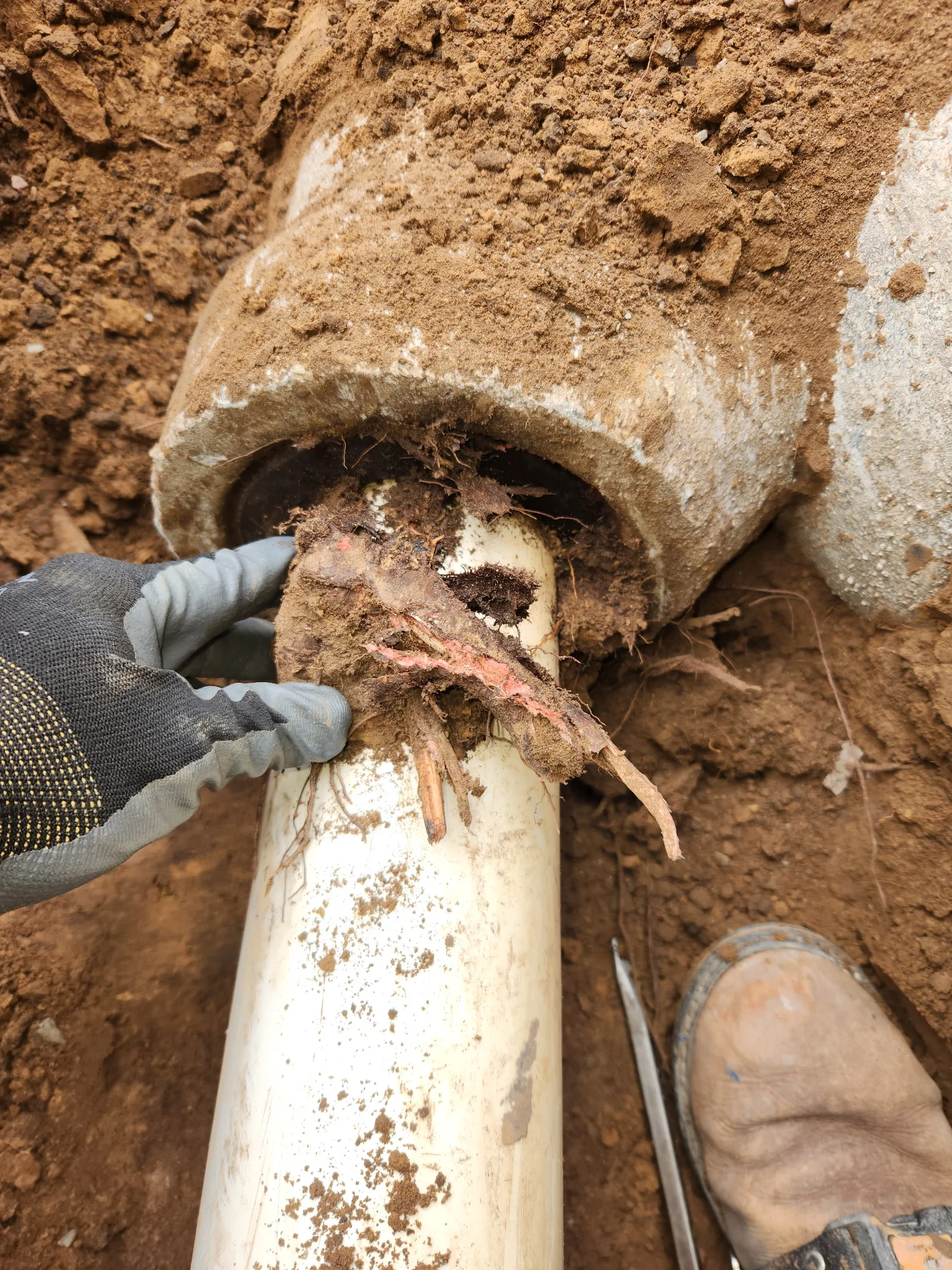
There’s a pipe running from your house to the city sewer main that you probably never think about. It handles every flush, every shower, every load of laundry, every dish you wash. It does its job quietly — until it doesn’t. And when a sewer lateral fails, it fails in ways that are expensive, disruptive, and often genuinely unpleasant.
I’ve been dealing with sewer line problems across Northern Utah for years, and the pattern I see over and over is homeowners who didn’t know they had a problem until raw sewage was backing up into their basement. They didn’t know what kind of pipe they had. They didn’t know they were responsible for it. They didn’t know their homeowners insurance wouldn’t cover it. And they definitely didn’t know the repair would cost $5,000 to $15,000.
This article is my attempt to give you the information before you need it, not after.
Key Takeaways
- Homeowners own and are responsible for the entire sewer lateral from the house to the city main — including sections under the sidewalk and street.
- Sewer line replacement typically costs $3,500-$15,000+ depending on depth, length, and surface restoration, and standard homeowners insurance does not cover it.
- A service line insurance endorsement costs just $30-$60 per year for $10,000-$15,000 in coverage — one of the highest-value insurance additions available.
- Homes built before 1980 should get a sewer camera inspection ($150-$300) to identify pipe material and condition before problems escalate.
- Root intrusion is the number one cause of sewer line problems across Northern Utah, with parkway trees being the biggest offenders.
You Own the Entire Sewer Lateral
This is the single most important fact in this article, and the one that surprises the most people: you, the homeowner, own and are responsible for the entire sewer lateral — from your house all the way to the connection at the city sewer main. That includes the section that runs under the sidewalk, under the park strip, and often under the street itself.
The city owns and maintains the sewer main (the large pipe that runs down the center of the street collecting waste from multiple homes). But the lateral — the 4-inch or 6-inch pipe that connects your home’s drain system to that main — is yours. If it clogs, breaks, collapses, or gets invaded by roots, the repair is your responsibility and your expense.
This is true in virtually every municipality along the Wasatch Front — Salt Lake City, Ogden, Provo, Layton, Bountiful, West Jordan, Sandy, and everywhere in between. Some cities will repair the section under the public right-of-way if it’s affecting the main, but don’t count on it. Check your specific city’s policy, and assume the worst until you have it in writing.
The Insurance Gap Most Homeowners Don’t Know About
Here’s the part that really stings: standard homeowners insurance policies typically do not cover sewer line repair or replacement. Your policy covers sudden, accidental damage from specified perils (fire, wind, falling objects, etc.), but the gradual deterioration, root intrusion, or collapse of a sewer pipe is considered a maintenance issue, not a covered peril.
This means the most common sewer line failure scenarios — root intrusion over years, pipe deterioration from age, bellying from soil settlement, Orangeburg pipe collapse — are all excluded from your standard policy.
However, most major insurers offer a sewer line or service line endorsement (sometimes called a rider) that you can add to your policy. This endorsement specifically covers repair and replacement of underground service lines, typically including sewer, water, and sometimes gas lines. The cost is remarkably reasonable:
- Typically $30-$60 per year for $10,000-$15,000 in coverage
- Available from most major carriers (State Farm, Allstate, USAA, American Family, etc.)
- Some policies cover the full replacement cost; others have a per-incident limit
Call your insurance agent today and ask about adding this endorsement. For the cost of a few pizzas per year, you’re protecting yourself against a five-figure expense. This is one of the highest-value insurance additions available to homeowners, and most people don’t know it exists until they’re standing in their basement watching sewage come out of the floor drain.
What Kind of Pipe Do You Have?
The type of sewer pipe connecting your home to the main depends almost entirely on when your home was built. Different eras used different materials, and some of those materials have finite lifespans that are now expiring across Northern Utah.
Pre-1950s: Vitrified Clay Tile
If your home was built before 1950, your sewer lateral is very likely vitrified clay (also called clay tile). This was the standard material for sewer lines from the late 1800s through the mid-20th century.
The good news: Clay is chemically inert — it doesn’t corrode, and it handles sewage well.
The bad news: Clay pipe is installed in 2-3 foot sections joined with mortar or bitumen. Over decades, those joints shift, separate, and open up — creating entry points for tree roots and groundwater infiltration. The pipe itself can also crack from external pressure or soil movement.
Older neighborhoods in Salt Lake City (the Avenues, Sugar House, 9th and 9th, Liberty Park), downtown Ogden, and Provo’s historic core are full of clay sewer laterals that are now 70-100+ years old. Many are still functional but compromised at the joints.
A note about Ogden specifically: Some older Ogden homes have shared sewer laterals — two or more homes connected to the same lateral before it reaches the main. This creates a unique situation where a problem in one home’s section affects the neighbor, and repair responsibility can become complicated. If you own an older home in Ogden, it’s worth determining whether your lateral is shared.
1930s-1972: Orangeburg Pipe
This is the one that causes the most grief. Orangeburg (also called “no-corrode” pipe, which is bitterly ironic) is a pipe made from layers of wood fiber and wood pulp, impregnated with hot coal tar pitch. It was lightweight, cheap, and easy to install — and it was widely used for sewer laterals from the 1930s through about 1972.
Orangeburg pipe has a design lifespan of 30-50 years. Do the math: pipe installed in the 1950s and 1960s is now 60-90+ years old. It’s well past its useful life, and it’s failing across Northern Utah.
Here’s what happens to Orangeburg as it ages:
- The tar-impregnated fiber gradually absorbs moisture and softens
- The pipe deforms, flattening from round into an oval or even collapsing completely
- Root penetration is easy because the material is soft enough for roots to push through
- A sewer camera will often show Orangeburg pipe that has “pancaked” — flattened to a fraction of its original diameter, drastically reducing flow capacity
If your home was built between 1945 and 1972, there’s a significant chance your sewer lateral is Orangeburg. Homes in the post-WWII housing boom neighborhoods of Murray, Kearns, Taylorsville, Midvale, and similar areas are particularly likely to have it. A sewer camera inspection is the definitive way to find out what you have.
Orangeburg cannot be effectively repaired or lined. When it fails, the only real solution is complete replacement.
1960s-1980s: Cast Iron
Cast iron sewer pipe was used in some homes from the 1960s through the 1980s, particularly for the section inside the building and occasionally for the lateral itself.
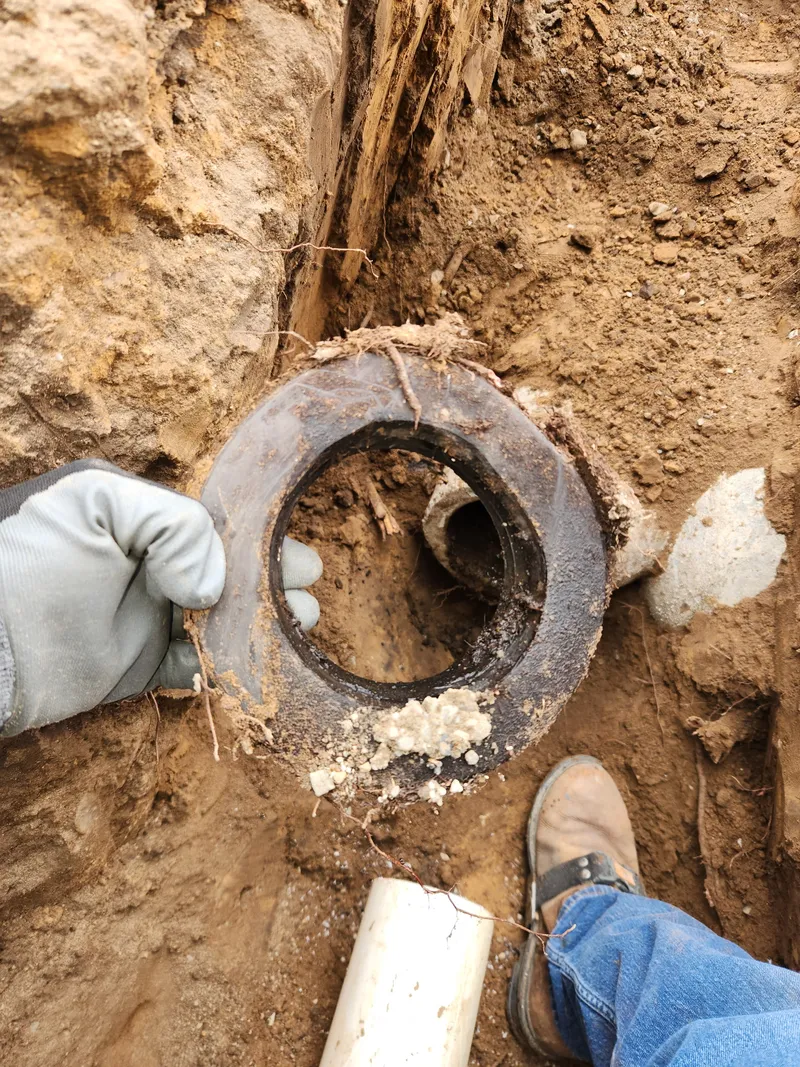
Cast iron is strong and durable, but it’s susceptible to internal corrosion over time. After 40-60 years, the interior of a cast iron pipe can corrode to the point where the pipe wall thins and eventually develops holes or channels. Hydrogen sulfide gas from sewage accelerates this corrosion, particularly along the top of the pipe (called the “crown”) where the gas concentrates.
Cast iron laterals from this era are approaching or past their expected service life. If your home was built in the 1960s-1980s and you experience slow drains, recurring clogs, or sewage odor, a camera inspection should be a priority.
Post-1980: PVC and ABS
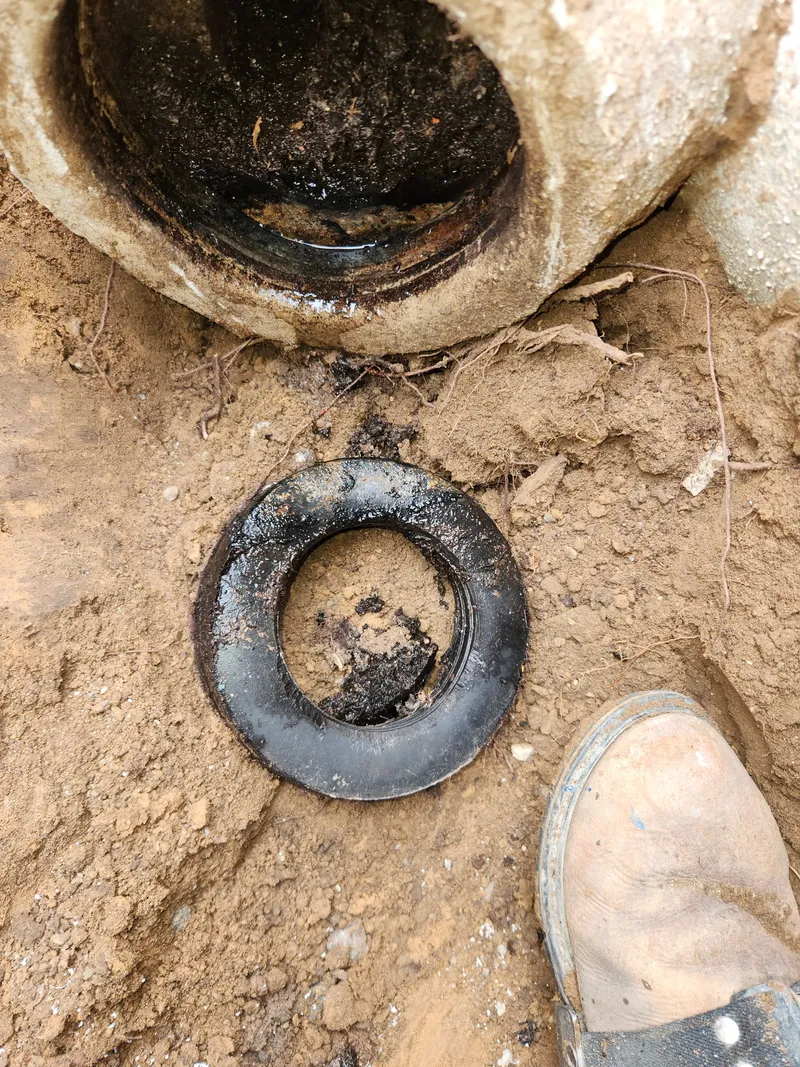
Starting in the late 1970s and becoming standard by the 1980s, PVC (polyvinyl chloride) and ABS (acrylonitrile butadiene styrene) plastic pipe replaced older materials for sewer laterals. These modern pipes have smooth interiors that resist root intrusion at the joints (when properly connected with solvent cement), don’t corrode, and have an estimated lifespan of 100+ years.
If your home was built after about 1985 with PVC or ABS, your sewer lateral is likely in good shape. The main risks for modern pipe are physical damage (from excavation, extreme soil movement, or improper installation) and bellying from soil settlement, which we’ll discuss below.
Sewer Pipe Materials by Era
| Era | Common Material | Expected Lifespan | Common Issues | Northern Utah Neighborhoods |
|---|---|---|---|---|
| Pre-1950s | Vitrified clay tile | 50-75+ years (joints fail first) | Joint separation, root intrusion at joints, cracking from soil movement; possible shared laterals in Ogden | The Avenues, Sugar House, downtown Ogden, Provo historic core |
| 1930s-1972 | Orangeburg (tar-impregnated wood fiber) | 30-50 years | Softening, deforming (“pancaking”), collapse, easy root penetration; cannot be lined or repaired — replacement only | Kearns, Taylorsville, Midvale, Murray, post-WWII neighborhoods |
| 1960s-1980s | Cast iron / Clay | 40-60 years (cast iron); 50-75+ years (clay) | Internal corrosion (crown erosion from H₂S gas), thinning pipe walls, holes; clay joints separate over time | Sandy, Draper, South Jordan, West Jordan (older sections) |
| Post-1980 | PVC / ABS plastic | 100+ years | Minimal — physical damage from excavation, bellying from soil settlement, improper installation | Herriman, Riverton, Saratoga Springs, Eagle Mountain, Daybreak |
Common Sewer Line Problems in Northern Utah
Beyond pipe material degradation, our local conditions create specific challenges for sewer lines.
Root Intrusion
This is the number one cause of sewer line problems across Northern Utah. Tree roots are naturally attracted to the moisture, nutrients, and oxygen that escape from sewer pipe joints and cracks. Roots can enter through remarkably small openings and then grow rapidly inside the pipe, eventually creating a root mass that blocks flow completely.
Parkway trees are the biggest offenders. The trees planted in the park strip between the sidewalk and street are directly above your sewer lateral in most neighborhoods. These are typically fast-growing, aggressive species — silver maples, willows, cottonwoods — with root systems that extend 20-30 feet or more from the trunk. They find your sewer line, and they don’t let go.
The particularly frustrating aspect: the city typically planted and maintains these trees, but the sewer lateral they’re destroying is your responsibility.
Root intrusion can be managed temporarily by having the roots cut out with a mechanical auger (rooter machine). This provides relief for 6-18 months depending on severity. Chemical root killers (copper sulfate or foaming root treatments) can slow regrowth. But if you’re dealing with recurring root intrusion, you’re spending $200-$400 every year or two on rooter service and still not solving the underlying problem. At some point, the math favors replacement with modern pipe.
Bellies and Sags
A “belly” in a sewer line is a low spot where the pipe has sagged due to soil settlement. This creates a section where water and waste pool instead of flowing smoothly toward the main. Over time, solids accumulate in the belly, bacteria build up, and the belly becomes a recurring clog point.
Northern Utah’s soil conditions make bellies particularly common:
- Freeze-thaw cycles cause soil expansion and contraction that gradually shifts pipe alignment
- Lake Bonneville clay deposits in many areas are expansive soils that move with moisture changes
- Irrigation and landscaping can create localized soil saturation that causes settlement
A belly can sometimes be resolved by excavating and re-grading just the affected section, but if multiple bellies exist along the line, replacement may be more cost-effective.
Offset Joints
In older pipe materials (clay and Orangeburg especially), joints between pipe sections can shift out of alignment due to soil movement. An offset joint creates a lip inside the pipe that catches debris, toilet paper, and other material, causing recurring partial blockages. Minor offsets can be tolerated; significant offsets require repair or replacement.
Ground Settling and Structural Failure
Along the Wasatch Fault zone, ground settling and minor seismic shifts occur over decades. These forces can crack rigid pipes, separate joints, and cause structural failures that are invisible until the line is scoped with a camera. Homes along the east benches of Salt Lake Valley, the Ogden bench, and other areas near the fault trace may be more susceptible.
Sewer Camera Inspections: Your Best Investment
A sewer camera inspection involves running a specialized waterproof camera through your sewer lateral from the house to the main. The camera transmits real-time video to a monitor, allowing the operator to see the interior condition of the entire pipe — material type, joint condition, root intrusion, bellies, cracks, offsets, and any other issues.
A sewer camera inspection typically costs $150-$300, and it’s one of the most valuable diagnostic tools in residential plumbing.
You should get a camera inspection if:
- Your home was built before 1980 and has never been scoped — you need to know what material you have and its current condition
- You’re buying a home — add a sewer scope to your home inspection. This is increasingly standard practice in Utah real estate, and any good buyer’s agent will recommend it. A $200 inspection before closing can save you from inheriting a $10,000 problem
- You’re experiencing slow drains or recurring clogs — rather than repeatedly snaking the line, find out what’s actually causing the problem
- You’ve had sewer backups — even one backup warrants a camera inspection to determine the cause
- There are large trees near the path of your sewer lateral
- You’re planning a major renovation — especially finishing a basement, which adds fixtures and increases demand on the lateral
When reviewing camera footage, pay attention to:
- Pipe material (the operator should identify it)
- Joint condition — separated, offset, or infiltrated joints
- Root presence — even small root tendrils indicate the pipe is compromised
- Bellies — you’ll see the camera submerge in standing water
- Pipe shape — round is good; oval or deformed indicates structural compromise (common in Orangeburg)
- Cracks, breaks, or missing sections
A good camera operator will also measure the approximate distance from the cleanout to any problems found, which is critical information if excavation is needed.
Repair Options and Costs
When a sewer lateral fails, you generally have three options:
Traditional Excavation and Replacement
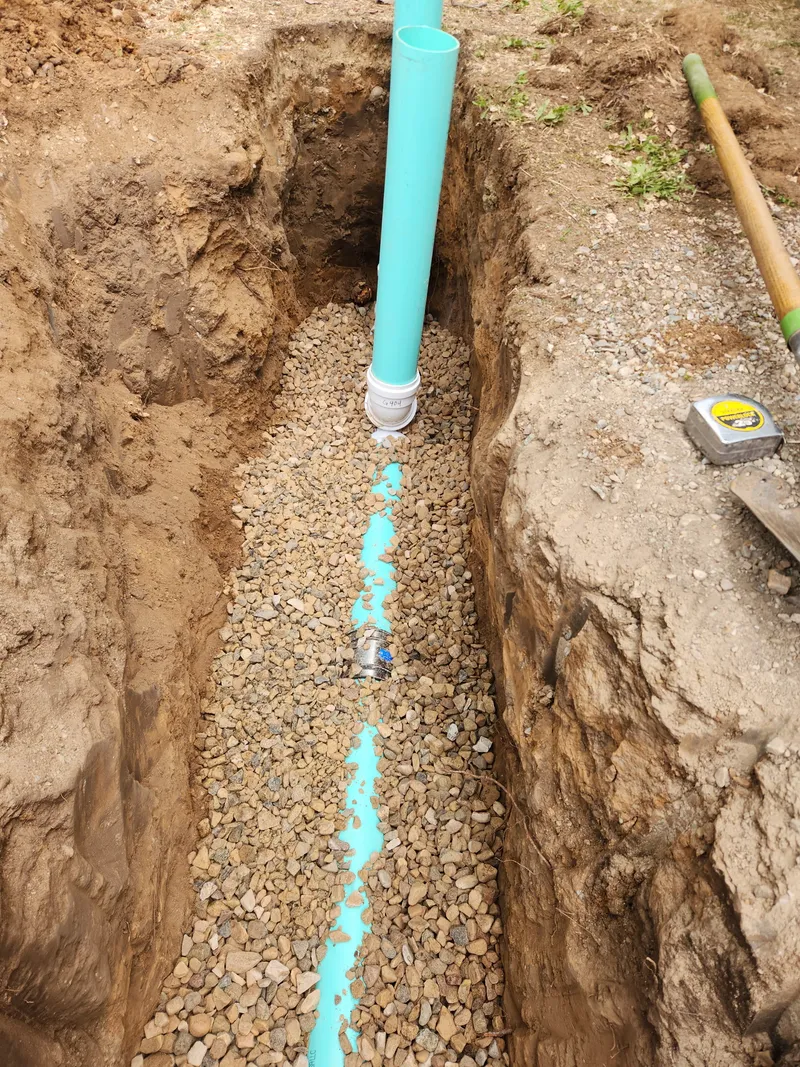
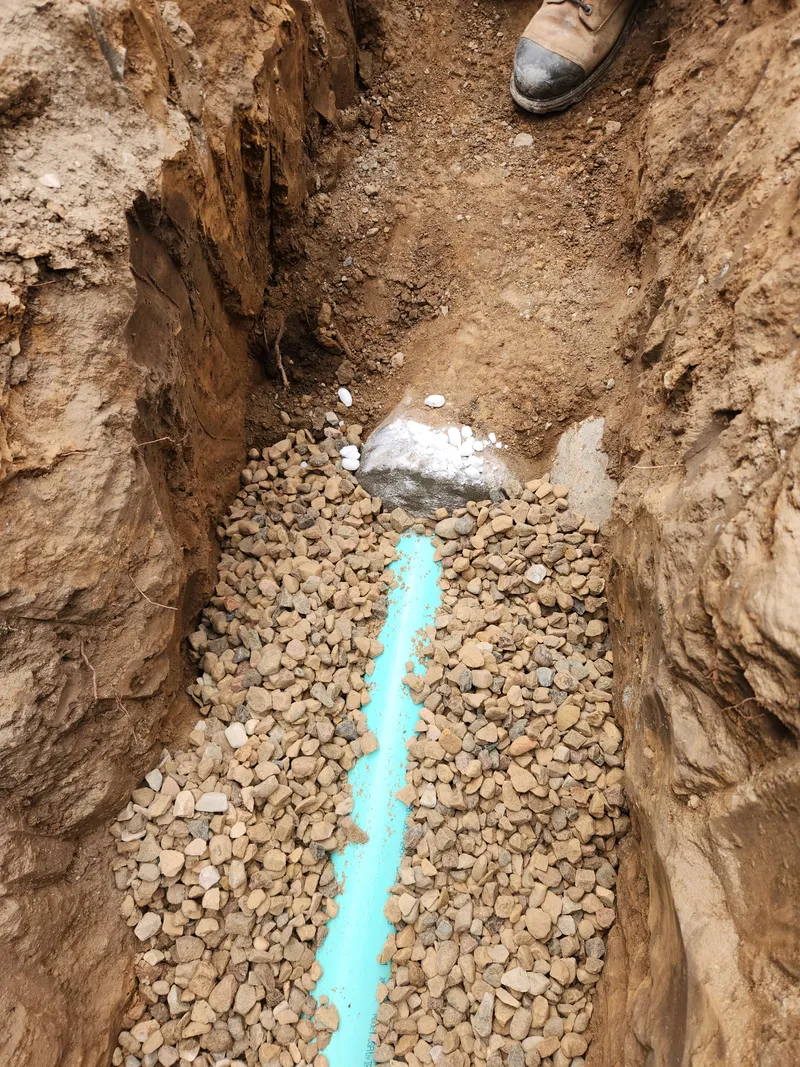
This is the most common approach and sometimes the only option. The old pipe is excavated, removed, and replaced with new PVC or ABS pipe. Cost depends heavily on:
- Depth: Shallow laterals (3-4 feet) are much cheaper to dig than deep ones (8-10+ feet, which is common when the main is in the center of the street)
- Length: A 40-foot lateral is cheaper than an 80-foot lateral
- Surface restoration: Digging through a front lawn is cheaper than digging through a driveway, sidewalk, or street (which requires pavement cutting and restoration, often with city permits)
- Access: Tight lots, fences, landscaping, and other obstacles increase cost
Typical range: $3,500 for a short, shallow, straightforward replacement up to $15,000+ for a long, deep lateral under a street with pavement restoration.
Trenchless Pipe Lining (CIPP)
Cured-in-place pipe (CIPP) lining involves pulling a resin-saturated liner through the existing pipe and inflating it against the pipe walls, where it cures to form a smooth, jointless new pipe inside the old one. This avoids excavation in most cases.
Pros: Minimal disruption to landscaping and surfaces; often faster than excavation.
Cons: Only works if the existing pipe is still largely intact (can’t line a collapsed pipe); reduces the internal diameter slightly; costs approximately the same as or more than traditional replacement in many cases; not all contractors offer it.
Typical range: $4,000-$12,000 depending on length and diameter.
Pipe Bursting
Pipe bursting pulls a new pipe through the existing pipe while simultaneously fracturing the old pipe outward into the surrounding soil. It requires access pits at each end but avoids continuous trenching.
Typical range: $4,000-$10,000.
Which Method Is Best?
It depends on your specific situation — pipe material, depth, location, condition, and access. A reputable plumber will camera-inspect the line, discuss options honestly, and recommend the approach that makes sense for your circumstances. Be cautious of any contractor who recommends a specific method before scoping the line.
Warning Signs of Sewer Line Problems
Don’t wait for a full backup. These signs suggest your lateral may be deteriorating:
- Slow drains throughout the house — if multiple fixtures drain slowly, the problem is likely in the main line, not individual drain traps
- Recurring clogs — if you’re calling for drain service more than once a year, there’s an underlying issue
- Gurgling sounds from drains or toilets, especially when other fixtures are running
- Sewage odor in the basement, crawl space, or yard — sewer gas escaping through cracks or separated joints
- Patches of unusually green, lush grass in the yard — sewage is an excellent fertilizer, and a leaking lateral will feed the lawn directly above it
- Foundation cracks or settling — a leaking lateral can erode soil beneath or near the foundation
- Sewage backup into the lowest drain in the house (typically a basement floor drain or shower) — this is the most obvious sign and means the problem is already severe
- Rodents or insects — rats and cockroaches can enter homes through cracked sewer pipes. If you have a sudden pest problem, your sewer line is worth investigating.
The Age Factor: A Guide for Northern Utah Neighborhoods
Understanding the general age of housing stock in different communities helps you assess your risk:
- Ogden historic district, downtown SLC, the Avenues: Many homes from the 1890s-1940s. Original clay sewer laterals are now 80-130 years old. Possible shared laterals in Ogden. High priority for inspection.
- Sugar House, 9th & 9th, Liberty Park, East Bench SLC: Mixed stock from 1920s-1960s. Clay or early Orangeburg laterals. Many large, mature trees with extensive root systems.
- Kearns, Taylorsville, Midvale, Murray: Post-WWII housing boom, 1945-1965. Prime Orangeburg territory. These laterals are at or past their design lifespan. If you own a home in these areas and have never scoped the line, do it.
- Sandy, Draper, South Jordan, West Jordan (older sections): 1960s-1980s. Mix of clay, cast iron, and early PVC. Variable condition.
- Newer suburbs (Herriman, Riverton west, Saratoga Springs, Eagle Mountain, Lehi west, Daybreak): Post-2000 construction with PVC/ABS laterals. Generally in good shape, though fast-growth landscaping may begin causing root issues as trees mature.
Frequently Asked Questions
Can I just keep snaking the line instead of replacing it? You can, but you’re managing a symptom, not solving the problem. Recurring root intrusion means the pipe has openings that will only get worse. Recurring clogs from a belly or offset joint won’t resolve without physical correction. If you’re spending $200-$400 per year on drain service, you’ll hit the cost of replacement within a few years — and meanwhile, you’re living with the risk of a full backup.
Should I get a sewer scope when buying a home? Absolutely, especially for any home built before 1985. A $200 inspection can reveal a $10,000 problem. If the scope reveals issues, you can negotiate with the seller for repair, a price reduction, or a credit at closing. Most buyer’s agents in Northern Utah now recommend sewer scopes as standard practice.
Can I dig up and replace the sewer line myself? Technically, a homeowner can work on their own property in most jurisdictions, but sewer line replacement requires excavation permits, proper slope (typically 1/4 inch per foot minimum), code-compliant materials and connections, and a city inspection. The section under the public right-of-way requires additional permits and typically must be done by a licensed contractor. Given the depth of excavation, utility conflicts (gas, water, electrical, and telecom lines are often in the same corridor), and the consequences of improper installation, this is not a good DIY project.
What about enzymatic or bacterial drain treatments — do they help? Bacterial drain treatments can help maintain a healthy sewer line by breaking down organic buildup. They won’t clear a serious clog, dissolve tree roots, or fix structural problems, but as a monthly maintenance treatment, they’re a reasonable practice. They’re not a substitute for professional inspection and service when problems exist.
Take Action Before the Emergency
Sewer line problems get worse, not better, over time. A minor root intrusion becomes a major blockage. A small belly becomes a recurring clog. An aging Orangeburg pipe that’s still working today can collapse without warning tomorrow.
The smartest things you can do right now:
- Call your insurance agent and add a sewer/service line endorsement. $30-$60/year for $10,000-$15,000 in coverage.
- Get a camera inspection if your home is pre-1980 or if you’ve experienced any warning signs. Budget $150-$300.
- Know your pipe material. If you have Orangeburg, start planning and budgeting for replacement.
- Manage your trees. If you’re planting new trees, keep them at least 10 feet from the sewer lateral path. Consider root barriers for existing trees near the line.
Our plumbing team performs sewer camera inspections and sewer line repair across Northern Utah. We’ll show you the camera footage, explain what we find, and give you honest recommendations. Check out our work to see the quality of service we deliver.
Call (385) 401-9490 or contact us online to schedule an inspection. The cost of knowing is a fraction of the cost of not knowing.
Topics