Heat Pump vs. Furnace in Utah: The Complete Comparison for Northern Utah Homes
Choosing the right heating system for a Northern Utah home is not the same decision it is in Portland, Atlanta, or Phoenix. Our climate is extreme — winter lows below zero in Cache Valley, summer highs above 100 degrees along the Wasatch Front, and an elevation range from 4,200 feet to over 7,000 feet. Add winter inversion events, altitude effects on gas combustion, and utility rate structures that differ from most of the country, and most national HVAC guides get this comparison wrong for our area.
This article breaks down the real-world differences between heat pumps and gas furnaces for Northern Utah — the costs, performance limits, and specific factors that should drive your decision. We also cover the hybrid dual-fuel option that is increasingly the smartest choice for Wasatch Front homeowners.
Key Takeaways
- A gas furnace costs $3,000-$6,000 installed and provides reliable heat at any temperature, but only heats — you still need a separate air conditioning system. A heat pump costs $5,000-$10,000 installed but provides both heating and cooling in one system.
- Standard heat pumps lose significant efficiency below 20-25 degrees Fahrenheit, which is a real limitation in Northern Utah. Cold-climate models (Mitsubishi Hyper-Heat, Daikin, Bosch) now operate down to -13 to -22 degrees Fahrenheit, making them viable for most of the Wasatch Front.
- Utah’s altitude requires gas furnace derating of 4% per 1,000 feet — a furnace in Salt Lake City at 4,300 feet is already derated roughly 17%, narrowing the efficiency gap between furnaces and heat pumps.
- A dual-fuel system (heat pump with gas furnace backup) handles approximately 80% of heating with the heat pump when temperatures are above 30 degrees and switches to gas for the coldest days — offering the best combination of efficiency, comfort, and reliability for most Wasatch Front homes.
- Heat pumps produce no combustion byproducts, meaning no carbon monoxide risk and better indoor air quality during winter inversions when opening windows for ventilation is impractical.
Why This Decision Matters More in Utah
The national conversation around heat pumps versus furnaces has shifted dramatically in the last five years. Federal tax credits, improving cold-climate technology, and rising natural gas prices have all pushed heat pumps into the mainstream. But the advice coming from coastal and southern markets does not translate directly to Northern Utah.
Here is why our situation is unique:
Extreme temperature range. We need systems that perform reliably from 5 below zero to 100-plus degrees. A system that excels at moderate heating but struggles in extreme cold is a liability here.
Altitude effects on gas furnaces. Every gas furnace along the Wasatch Front must be derated — 4% less capacity for every 1,000 feet above sea level. A 100,000 BTU furnace in Salt Lake City only delivers about 83,000 BTU. In Park City, roughly 72,000 BTU. This narrows the performance gap between gas furnaces and heat pumps. Our article on gas appliance altitude adjustments in Utah covers this in detail.
Winter inversions and indoor air quality. During inversion events, pollutant concentrations spike to unhealthy levels. Gas furnaces introduce combustion byproducts through combustion air draw, while heat pumps involve no combustion at all.
Utility rate structures. Northern Utah residents get electricity from Rocky Mountain Power ($0.11-$0.13/kWh) and gas from Dominion Energy ($0.80-$1.10/therm). These rates, combined with system efficiency ratings, determine your actual monthly heating bills.
Gas Furnaces: How They Work
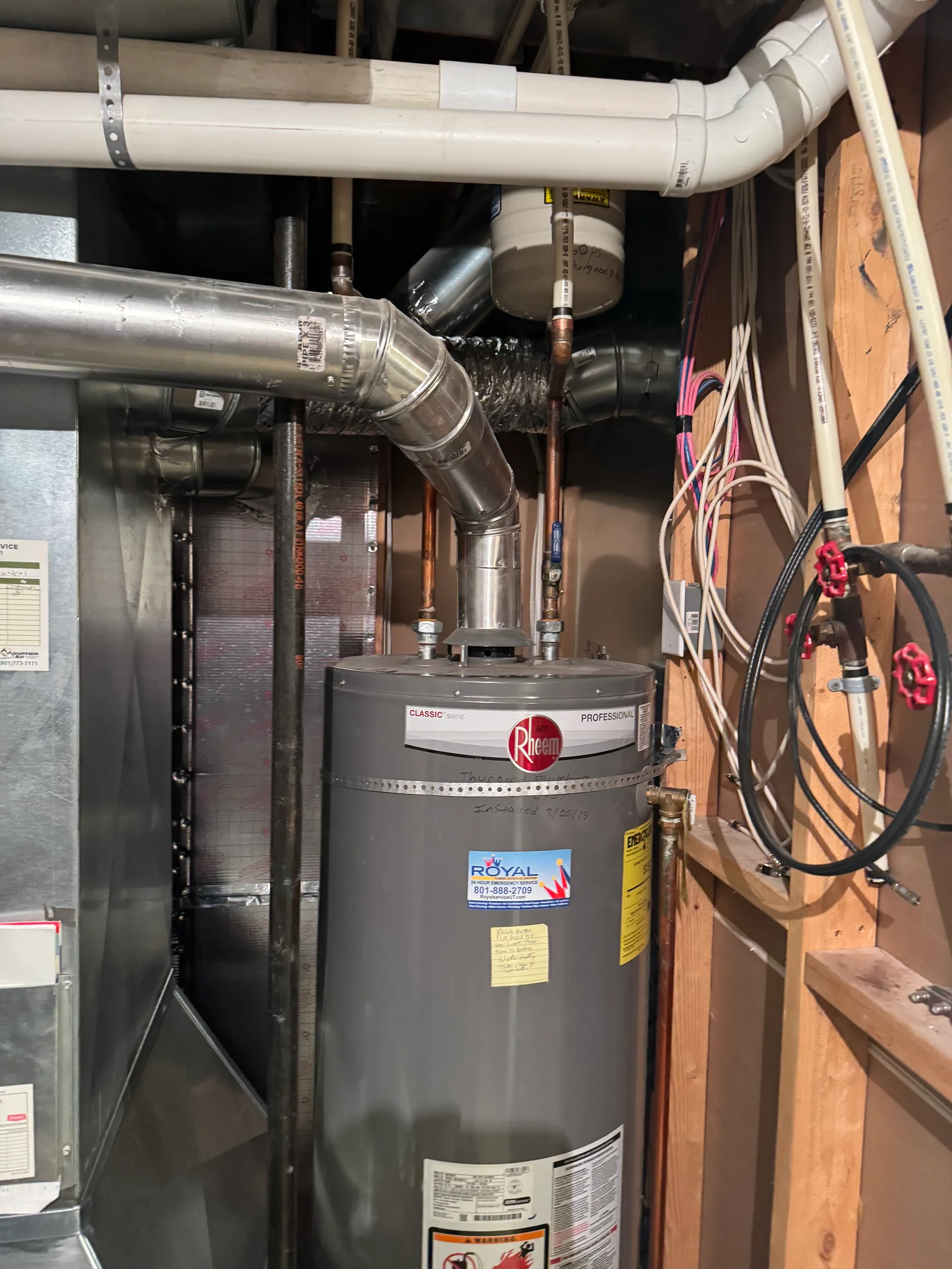
A gas furnace burns natural gas in a sealed combustion chamber. A heat exchanger transfers that combustion heat to the air flowing over it, and a blower fan distributes the heated air through your ductwork to every room in the house. Combustion exhaust is vented outside through a flue pipe — either up through the roof (standard efficiency) or out through a sidewall (high-efficiency condensing units).
Furnace efficiency is measured by AFUE (Annual Fuel Utilization Efficiency) — the percentage of fuel energy that is converted to usable heat. A standard furnace runs 80% AFUE. A high-efficiency condensing furnace runs 90-98% AFUE by extracting additional heat from the exhaust gases before they leave the house.
Pros of Gas Furnaces
Reliable heat at any temperature. A gas furnace does not care whether it is 30 degrees or 30 below zero outside. It burns fuel and produces heat. Period. There is no temperature at which it stops working or loses significant capacity. For the coldest nights in Cache Valley, Logan, or mountain communities, this reliability is not a minor point — it is essential.
Lower installation cost. A high-efficiency gas furnace professionally installed in a Northern Utah home typically costs $3,000 to $6,000, depending on the unit size, efficiency rating, and complexity of the installation. If you already have gas lines and existing ductwork, the installation is relatively straightforward.
Familiar technology. Gas furnaces have been the standard in Utah for decades. Every HVAC contractor along the Wasatch Front knows how to install, maintain, and repair them. Parts are widely available. The technology is mature and well-understood.
Fast heat delivery. Gas furnaces produce air temperatures of 120-140 degrees Fahrenheit at the supply registers. When you turn up the thermostat on a cold morning, you feel warm air quickly. Heat pumps produce lower supply air temperatures (90-110 degrees), which some homeowners perceive as cool or drafty even though the system is heating effectively.
Cons of Gas Furnaces
Gas only heats. A furnace provides zero cooling. You still need a separate air conditioning system for summer, which means a second outdoor unit, a second set of refrigerant lines, and a second maintenance schedule. When comparing costs, the furnace price alone does not tell the whole story — you need to add the cost of an AC unit ($3,000-$5,000 installed) for a complete picture.
Combustion and CO risk. Any gas appliance produces carbon monoxide as a byproduct of combustion. A properly installed and maintained furnace vents these gases safely outside. But cracked heat exchangers, improper venting, or insufficient combustion air — all of which we encounter regularly in Northern Utah homes — create real carbon monoxide hazards. CO detectors are mandatory, not optional.
Altitude derating reduces actual capacity. That 100,000 BTU furnace you purchased does not deliver 100,000 BTU in Utah. At Salt Lake City’s elevation, it delivers roughly 83,000 BTU. At Heber City, roughly 78,000 BTU. At Park City, roughly 72,000 BTU. Your HVAC contractor should size the furnace based on your altitude-derated capacity, not the nameplate rating. Many do not, which leads to undersized systems that run constantly during cold snaps.
Combustion air requirements at elevation. Gas furnaces need a supply of fresh air for combustion, and the required opening sizes increase at altitude — roughly 33% more combustion air opening than sea level for most Wasatch Front communities. Finished basements and enclosed mechanical rooms frequently lack adequate combustion air, leading to inefficient combustion and potential safety issues.
Heat Pumps: How They Work
A heat pump is essentially an air conditioner that can run in reverse. In cooling mode, it extracts heat from your indoor air and dumps it outside — exactly like a traditional AC unit. In heating mode, it extracts heat from the outdoor air and moves it inside. Yes, there is usable heat in outdoor air even at low temperatures. The refrigerant cycle allows the system to concentrate that heat and deliver it indoors.
The critical metric for Utah is the COP (Coefficient of Performance) at various outdoor temperatures. COP represents how many units of heat the system delivers per unit of electrical energy consumed. At 47 degrees Fahrenheit, a good heat pump delivers a COP of 3.0 to 4.0 — meaning for every unit of electricity consumed, it delivers 3 to 4 units of heat. That is 300-400% efficient. No gas furnace can touch that. But COP drops as outdoor temperatures fall. At 17 degrees, COP might be 2.0-2.5. Below zero, a standard heat pump’s COP can approach 1.0 — essentially an expensive electric resistance heater. That is where the Utah-specific concerns come in.
Pros of Heat Pumps
Both heating and cooling in one system. Instead of buying a furnace and a separate AC unit, you get one system that handles both. For new construction or a complete system replacement, total installed cost can be competitive with a furnace-plus-AC combination.
Highly efficient above 30 degrees. For the majority of Northern Utah’s heating season — October through early December, and March through April — outdoor temperatures are above 30 degrees. During these months, a heat pump operates at COP values of 2.5 to 4.0, delivering heat at a fraction of the cost of gas combustion.
No combustion, no CO risk. A heat pump is an all-electric system. No gas line, no burner, no flue, no combustion air requirement, and no carbon monoxide. For homeowners concerned about indoor air quality during winter inversions, this is a meaningful safety and health advantage.
Lower operating cost in mild weather. When the COP is above 2.5, heat pump heating costs less than gas at current Utah utility rates. Over a full heating season, this translates to $200 to $500 per year in savings for Wasatch Front homes.
Federal tax credits. As of 2026, qualifying heat pump installations can receive federal tax credits of up to $2,000 under the Inflation Reduction Act. Rocky Mountain Power may also offer additional rebates for qualifying high-efficiency equipment.
Cons of Heat Pumps
Efficiency drops significantly below 20-25 degrees. This is the fundamental concern for Northern Utah. A standard heat pump at 10 degrees Fahrenheit is working hard with diminishing returns. Below zero — which is common in Cache Valley, the Heber Valley, and mountain communities — a standard heat pump is essentially useless as a primary heat source. The system’s supplemental electric resistance heat strips kick in, and those run at COP 1.0 (100% efficient), which is expensive.
Higher upfront cost. A quality heat pump system, professionally installed, runs $5,000 to $10,000 in Northern Utah depending on size, efficiency rating, and whether it is a ducted split system, a ductless mini-split, or a packaged unit. For a premium cold-climate model, expect the higher end of that range.
May need supplemental heat. For most Northern Utah locations, a heat pump alone — even a cold-climate model — benefits from a backup heat source for the coldest nights. This is either electric resistance heat strips (included in most air handler units) or a gas furnace (the dual-fuel approach). Either way, you are not fully eliminating the need for secondary heating capacity.
Supply air temperature perception. Gas furnaces deliver 120-140 degree air at the register. Heat pumps deliver 90-110 degrees. Both heat effectively, but heat pump air can feel lukewarm to homeowners accustomed to the blast of a furnace. It is a comfort perception issue, not a performance issue.
Altitude considerations still apply. Heat pumps avoid gas combustion derating, but refrigerant charge may need adjustment at altitude, and any gas furnace backup still needs standard derating.
Cold-Climate Heat Pumps: A Game-Changer for Utah
The heat pump conversation changed dramatically when manufacturers released cold-climate models designed to operate efficiently at temperatures that would shut down a standard unit. These are worth understanding because they fundamentally alter the viability of heat pumps in Northern Utah.
Mitsubishi Hyper-Heat systems maintain rated heating capacity down to 5 degrees Fahrenheit and continue operating down to -13 degrees Fahrenheit. Even at -13, they are delivering meaningful heat — not just running emergency backup.
Daikin Fit and Aurora series units operate down to -13 to -22 degrees Fahrenheit, with some models maintaining significant capacity even at those extremes.
Bosch IDS 2.0 heat pumps deliver heat down to -4 degrees Fahrenheit with solid performance.
These are not theoretical numbers. These systems are installed and running in climates as harsh as Minnesota, Vermont, and Alaska. For most of the Wasatch Front — Salt Lake City, Ogden, Layton, Provo — where winter lows typically range from 10 to 25 degrees, a cold-climate heat pump handles the vast majority of the heating season without breaking a sweat.
The caveat is that even these advanced units lose efficiency at extreme cold. At -10 degrees, a cold-climate heat pump might run at COP 1.5-2.0. That is still better than electric resistance heating, but it is not the COP 3.0-4.0 you get at moderate temperatures. For the handful of nights per year when Salt Lake Valley drops into the single digits, the system works but works harder and costs more per hour.
Side-by-Side Comparison
| Factor | Gas Furnace | Heat Pump | Dual-Fuel (Heat Pump + Furnace) |
|---|---|---|---|
| Upfront cost (installed) | $3,000 - $6,000 (heating only) | $5,000 - $10,000 (heating and cooling) | $7,000 - $14,000 (complete system) |
| Includes AC? | No (add $3,000-$5,000 for AC) | Yes | Yes |
| Total cost for heating + cooling | $6,000 - $11,000 | $5,000 - $10,000 | $7,000 - $14,000 |
| Estimated annual operating cost | $800 - $1,400 | $500 - $1,000 (with supplemental heat) | $400 - $900 |
| Efficiency rating | 80-98% AFUE | 9-13 HSPF2 / 15-22 SEER2 | Best of both |
| Performance below 20 degrees F | No capacity loss | Standard models lose significant efficiency; cold-climate models maintain most capacity to -13 to -22 degrees F | Heat pump covers mild weather; furnace covers extreme cold |
| Typical lifespan | 15-20 years | 12-18 years | 15-20 years (furnace); 12-18 years (heat pump) |
| Altitude impact | Requires 4% derating per 1,000 ft (significant capacity loss) | Minimal combustion impact (refrigerant charge may need adjustment) | Furnace component requires derating |
| Carbon monoxide risk | Yes (requires CO detectors, proper venting) | None | Furnace component only |
| Indoor air quality (inversions) | Combustion air draw can affect IAQ | No combustion, better IAQ | Primarily electric heating reduces combustion hours |
Utah-Specific Factors
Geography Determines the Best Choice
Northern Utah is not one climate — it is several. The best heating system depends heavily on where you live:
Cache Valley and Logan (4,500 ft, regularly below 0 degrees F). Cache Valley’s cold-air pooling produces some of the coldest winter temperatures in the lower 48 states. January lows regularly hit -5 to -15 degrees Fahrenheit, with occasional extremes below -20. Even cold-climate heat pumps struggle at these temperatures. A high-efficiency gas furnace remains the most reliable primary heat source for Cache Valley homes. A dual-fuel system can work here, but the furnace will carry a larger share of the heating load than in the Salt Lake Valley.
Salt Lake Valley and Wasatch Front (4,200-4,600 ft, typical winter lows 15-25 degrees F). The sweet spot for heat pumps and dual-fuel systems. Most winter nights stay above 15 degrees, with only a handful dipping to single digits. A cold-climate heat pump handles 80-90% of the heating season independently. A dual-fuel system provides the lowest total operating cost.
Heber Valley and Park City (5,600-7,200 ft, winter lows 0-15 degrees F). Higher elevation means colder temperatures and more severe altitude derating. A gas furnace at Park City loses 28% of rated capacity, which narrows the gap between a derated furnace and a heat pump. Dual-fuel works well here, with the heat pump covering the majority of the season and the furnace handling the coldest nights.
Altitude Derating Narrows the Gap
A 96% AFUE gas furnace sounds impressively efficient. But after altitude derating in Salt Lake City, that furnace only delivers about 80% of its nameplate BTU capacity. The combustion process is still efficient, but total system output drops because the burner receives less fuel through the altitude-adjusted orifice. A heat pump does not suffer this penalty — its efficiency comes from the refrigerant cycle, not combustion. The real-world efficiency gap between a gas furnace and a heat pump in Northern Utah is narrower than nameplate numbers suggest.
Winter Inversions and Indoor Air Quality
During a typical winter, the Wasatch Front experiences multiple inversion events where PM2.5 levels exceed EPA health standards. Gas furnaces — particularly older natural-draft models — draw combustion air that ultimately pulls outdoor air into the home through the building envelope. During an inversion, that means pulling polluted air indoors. A heat pump sidesteps this entirely. No combustion means no combustion air requirement — a significant benefit for households with asthma, allergies, or respiratory conditions.
Utility Costs: Electricity vs. Gas
The operating cost comparison depends on local utility rates. In Northern Utah as of 2026, Rocky Mountain Power residential electricity runs approximately $0.11-$0.13 per kWh, while Dominion Energy natural gas averages roughly $0.80-$1.10 per therm. At these rates, gas is cheaper per unit of heat at moderate temperatures. But during shoulder season months — October, November, March, April — when outdoor temperatures stay above 35-40 degrees and the heat pump runs at COP 3.5-4.0, the heat pump can be cheaper to operate than the furnace.
A dual-fuel system exploits this by automatically switching to whichever source is most cost-effective. A properly set switchover point (typically 30-35 degrees Fahrenheit) optimizes operating cost across the full season.
The Dual-Fuel Option: Best of Both Worlds
For most Wasatch Front homes, a dual-fuel system is the answer that makes the most sense. Here is how it works.
A dual-fuel system pairs a heat pump (the outdoor unit) with a gas furnace (the indoor unit, which also serves as the air handler). A thermostat or control board manages the switchover between the two heat sources based on outdoor temperature.
Above the balance point (typically 30-35 degrees F): The heat pump handles all heating. It is running at COP 2.5 to 4.0, delivering heat more efficiently than the gas furnace.
Below the balance point: The system switches to the gas furnace, which provides reliable, full-capacity heat regardless of outdoor temperature.
In summer: The heat pump runs in cooling mode as a high-efficiency air conditioner.
The result is a system that uses the heat pump for roughly 80% of the heating hours — the milder days that make up most of the season — and gas for the remaining 20% when temperatures drop below the point where the heat pump’s efficiency advantage disappears. Total operating cost is lower than either system running alone, and you have the reliability of gas backup for the coldest nights.
The downside is upfront cost — $7,000 to $14,000 installed from scratch. But if you are replacing both a furnace and AC simultaneously (both often reach end-of-life around the same time), the incremental cost is smaller, and operating savings compound over 15+ years.
Our Recommendation
For most Wasatch Front homes (Salt Lake City, Ogden, Layton, Bountiful, Provo, and surrounding communities), a dual-fuel system — heat pump with gas furnace backup — offers the best combination of efficiency, comfort, and reliability. The heat pump covers the majority of the heating season at lower operating cost, and the furnace provides dependable heat when temperatures drop below the mid-20s.
For Cache Valley and mountain homes that regularly see sub-zero temperatures, a high-efficiency gas furnace remains the most dependable primary heat source. A dual-fuel system can work in these areas, but the furnace will handle a larger portion of the heating load, reducing the operating cost advantage of the heat pump component. For these locations, the math may not justify the additional cost of the heat pump unless you also need a new AC system.
For new construction, we strongly recommend discussing dual-fuel with your builder during the design phase. The incremental cost to install a dual-fuel system versus a furnace-plus-AC is lowest during new construction when all the infrastructure is being installed anyway.
Frequently Asked Questions
Can a heat pump really heat my home when it is 10 degrees outside? Yes, if it is a cold-climate model. Mitsubishi Hyper-Heat, Daikin, and Bosch units maintain meaningful heating capacity well below 10 degrees. For the Wasatch Front, where 10-degree nights happen a handful of times per winter, a cold-climate heat pump with supplemental backup is a viable option.
Will a heat pump work with my existing ductwork? In most cases, yes. However, because heat pump supply air temperatures are lower than furnace air (90-110 degrees vs. 120-140 degrees), proper duct sizing and sealing become more important. We evaluate ductwork as part of every heat pump installation.
How long do heat pumps last in Utah’s climate? A quality heat pump typically lasts 12-18 years, compared to 15-20 years for a gas furnace. The heat pump runs year-round, meaning more total operating hours. Regular maintenance — annual tune-ups, coil cleaning, refrigerant checks — is essential to reach the upper end of that range.
Are there tax credits available for heat pump installation in Utah? Yes. As of 2026, the federal Inflation Reduction Act provides tax credits of up to $2,000 for qualifying heat pump installations, both ducted and ductless. Rocky Mountain Power may also offer rebates. Confirm current incentives with your tax advisor and check Rocky Mountain Power’s website for active programs.
Make the Right Heating Decision for Your Home
The furnace-versus-heat-pump decision is not one-size-fits-all — especially in Northern Utah, where altitude, extreme temperatures, and inversion-related air quality concerns add layers of complexity that do not exist in most of the country. Whether you are replacing a failing furnace, upgrading from an aging AC system, or building new, the right system depends on where you live, how your home is built, and what matters most to you.
Our HVAC team works across the entire Wasatch Front and understands the specific requirements of heating at Utah’s elevation and in our climate. We will evaluate your home, run the numbers on operating costs with current utility rates, and give you a recommendation that makes sense for your situation — not a sales pitch for whatever system we have in stock.
Call us at (385) 401-9490 or contact us online to schedule a heating system consultation. Whether you need a straightforward furnace replacement or want to explore a dual-fuel upgrade, we will help you make a decision you will be comfortable with for the next 15-20 years.
Topics